How to Use Customer Journey Mapping to Identify Feedback Touchpoints in 2026
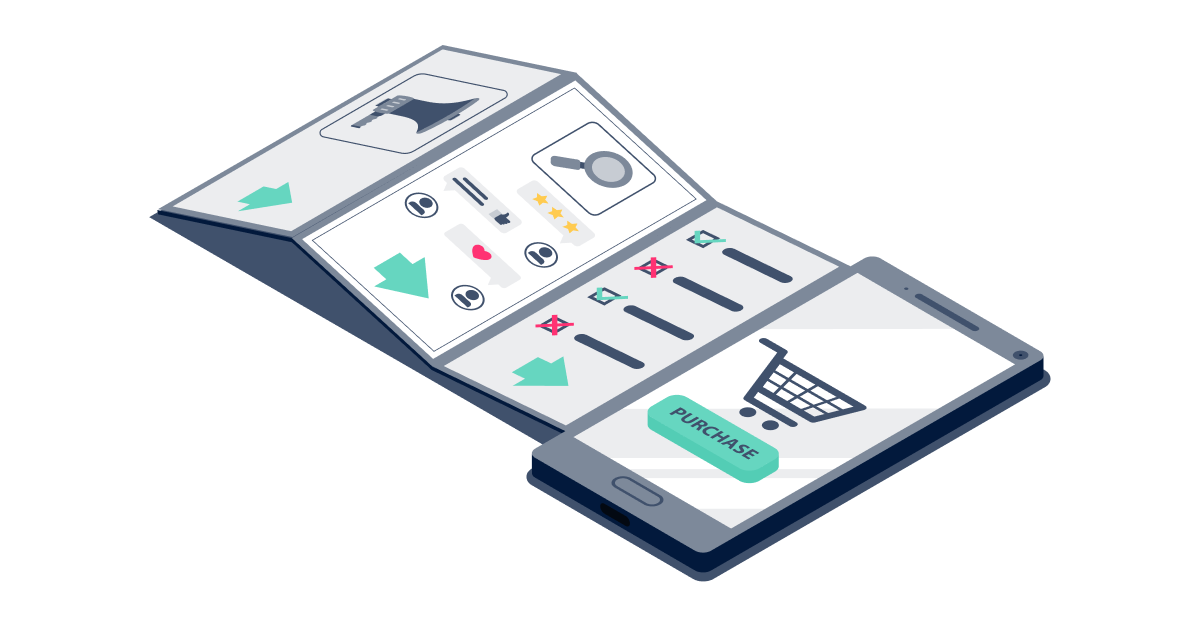
Most CX teams already have feedback data. What they lack is a clear picture of where that feedback belongs in the customer journey — and what to do with it once they have it.
Customer journey mapping solves the first problem. A platform that acts on feedback automatically solves the second. This article covers both — and if you want the full methodology, our updated white paper Customer Journey Mapping — A Guide to Touchpoints (2026 Edition) walks through the complete process step by step, including a visual template and a ready-to-use feedback touchpoint matrix.
Table of Contents
- What Customer Journey Mapping Actually Does for CX Teams
- Why 2026 Journeys Need a New Map
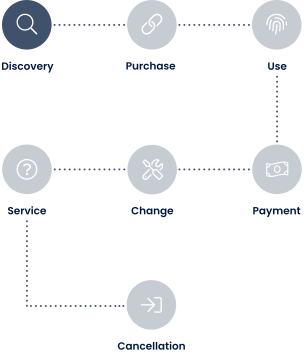
- The Five Stages of a Customer Journey (and Where Feedback Belongs)
- How to Build Your Feedback Touchpoint Map
- Common Mistakes in Feedback Touchpoint Mapping
- Turning Your Journey Map Into an Action System
- Industry-Specific Touchpoints Worth Mapping
- Close the loop after every touchpoint
- FAQs
What Customer Journey Mapping Actually Does for CX Teams
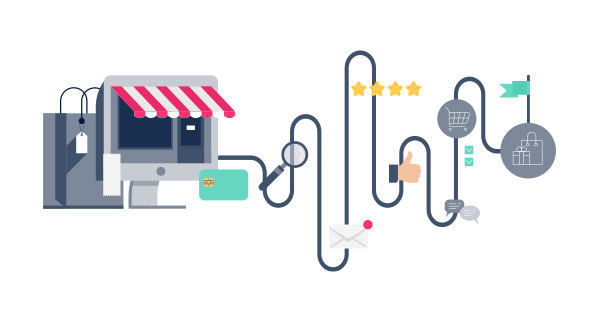
A customer journey map is a structured view of every interaction a customer has with your brand — from first awareness through post-purchase and renewal. It shows you the sequence of steps, the channels involved, and the emotional state a customer is likely in at each point.
For CX leaders, the value isn’t the map itself. It’s what the map reveals: the moments where customers form lasting opinions about your brand, where dissatisfaction builds quietly, and where a well-timed question can surface a problem before it becomes churn.
Without a journey map, feedback collection tends to cluster around the easiest touchpoints — post-purchase emails, annual surveys, support ticket follow-ups. Those matter, but they miss most of the story.

Why 2026 Journeys Need a New Map
If your journey map was built before 2024, it’s likely missing the touchpoints that now shape buying decisions:
AI-mediated discovery. Customers increasingly meet your brand through AI search summaries and chatbot recommendations — before they ever visit your website. What those assistants say about you is shaped by reviews and public feedback, not by your own channels.
Platform-native journeys. Discovery, comparison, and even checkout can happen entirely inside social platforms, without a single session on your site.
Survey fatigue as a design constraint. Survey requests have risen more than 70 percent since 2020, while response rates for generic email surveys have dropped to single digits in many industries. Every feedback ask now has to earn its place.
You can’t place a survey at touchpoints you don’t control — but your map should include them, because they create the expectations your owned touchpoints have to meet. How to handle these “invisible” touchpoints, and which listening posts to use instead, is covered in depth in chapter 4 of the white paper.

The Five Stages of a Customer Journey (and Where Feedback Belongs)
Every industry has its own journey shape, but most follow a recognizable pattern. Here’s how to think about feedback placement at each stage.
1. Awareness and Consideration
The customer is evaluating options. They may have visited your website, seen an ad, read a review — or asked an AI assistant for a recommendation. Direct feedback is harder to collect here, but signals like content engagement and chat interactions tell you whether your messaging matches what customers actually need.
For B2C retail and financial services, this stage often plays out across multiple channels at once. Map it carefully — misalignment between what you promise here and what you deliver later is one of the most common sources of early churn.
2. Onboarding and First Use
This is the highest-stakes stage for most businesses. A customer who has a poor first experience rarely gives you a second chance. An NPS or CSAT survey sent within the first 48 to 72 hours of onboarding gives you a real-time read on whether your product or service is landing as expected.
For energy providers and internet services, this is often the moment customers decide whether they made the right choice. A detractor at this stage isn’t just unhappy — they’re a cancellation risk.
3. Ongoing Engagement
Regular customers interact with your brand repeatedly, and each interaction is a potential feedback moment: a support call, a delivery, a bill, a renewal notice. The challenge isn’t finding touchpoints — it’s choosing the right ones to survey without fatiguing your customers.
A good rule of thumb: survey at moments of transition. After a support interaction closes. After a product update ships. After a renewal. These are moments when customers are already forming a judgment.
4. Service Recovery
Something went wrong. A complaint was filed, a delivery was missed, a charge was disputed. This is a critical feedback touchpoint that many teams underuse. A well-timed survey after a service recovery interaction tells you whether the resolution actually worked — and gives you a chance to re-engage a customer who might otherwise leave quietly.
Thalia used automated win-back workflows through zenloop to recover 70 percent of dissatisfied customers. That result starts with knowing exactly when and where a customer became dissatisfied in the first place.
5. Renewal and Exit
Renewal is a natural survey moment. So is cancellation — though most teams only survey customers after they’ve already left, which is too late to act.
Map your renewal journey carefully. Identify the 30, 60, and 90-day windows before renewal where feedback can still influence the outcome. A customer who scores you a 6 or 7 on NPS three months before renewal is telling you something important. Act on it then, not after they churn.
How to Build Your Feedback Touchpoint Map
Here’s the framework in four steps. The white paper expands this into a full six-step process — including the questions to ask your team at each step, which data sources to build on, and a complete worked example.
Step 1: List Every Customer Interaction
Start with a complete touchpoint analysis: list every interaction across all channels — digital touchpoints (website, app, email), human touchpoints (sales calls, support), and operational touchpoints (billing, delivery, installation). Don’t filter yet. Just capture everything. Build on real data — support logs, analytics, existing feedback — not internal assumptions.
Step 2: Identify Moments of Emotional Significance
Not every interaction deserves a survey. Focus on the 5–8 “moments of truth” where customers form strong opinions: first use, first problem, first resolution, renewal, and exit. These are the touchpoints where feedback is most predictive of future behavior.
Step 3: Assign a Feedback Method to Each Touchpoint
NPS works well at relationship-level moments — after onboarding, at renewal. CSAT works better at transactional moments — after a support call, after a delivery. CES (Customer Effort Score) is the strongest choice right after high-effort interactions like checkout, returns, or support contacts. Match the survey type to the question you actually need answered — and ask in the channel where the experience happened, while it’s still fresh.
The white paper includes a complete touchpoint-by-touchpoint matrix — which metric, which channel, and which timing for each moment of truth — that you can adapt directly to your own journey.
Step 4: Define What “Acting on Feedback” Looks Like at Each Point
This is where most journey maps stop short. A touchpoint without a defined response workflow is just data collection. For each feedback touchpoint, define what triggers a follow-up, who owns the response, and what the customer hears back.
If a detractor submits a low score after onboarding, does your team know within 24 hours? Does an automated workflow reach out? Does the customer hear anything at all? The answers to these questions determine whether your journey map creates real retention value or just fills a dashboard.

Common Mistakes in Feedback Touchpoint Mapping
Surveying too often. Survey fatigue is real — the average consumer now receives roughly a dozen survey requests per month. When customers receive a survey after every interaction, response rates drop and the data becomes less reliable. Prioritize the touchpoints that matter most. (The white paper dedicates a full chapter to designing against survey fatigue, including contact rules you can enforce across teams.)
Treating all detractors the same. A detractor who churned two weeks ago needs a different response than one who is still active and reachable. Your journey map should distinguish between these segments.
Ignoring the gap between feedback and action. Collecting feedback at the right touchpoints is only half the job. If that feedback sits in a dashboard unread, it costs you customers. The map needs an action layer, not just a collection layer.
Mapping the journey you designed, not the one customers actually take. Talk to your support team, your sales team, and your customers. The journey customers experience often looks very different from what your internal process documentation describes.

Turning Your Journey Map Into an Action System
A journey map is a planning tool. The real work happens when you connect each feedback touchpoint to an automated response.
For teams managing feedback at scale, that means setting rules that trigger automatically based on survey responses. A promoter at renewal gets enrolled in an advocacy program. A detractor after onboarding gets a personal outreach from a customer success manager. A passive responder after a support interaction gets a follow-up email three days later.
This is the difference between measuring customer experience and managing it. The map tells you where to listen. The automation tells you what to do next.
zenloop is built for exactly this workflow — collecting NPS, CSAT, and CES at the touchpoints your journey map identifies, then triggering the right action for each response segment automatically. The IRIS analysis engine surfaces which touchpoints are generating the most dissatisfaction and prioritizes where your team should focus first.

Industry-Specific Touchpoints Worth Mapping
Different industries have different high-stakes moments. These are the ones that consistently produce the most actionable feedback.
Retail: Post-purchase delivery confirmation, first return experience, loyalty program enrollment, seasonal reactivation.
Energy: Installation or switch completion, first bill receipt, outage resolution, annual contract renewal.
Financial services: Account opening, first transaction, loan decision communication, annual review, complaint resolution.
Internet services: Installation, first service disruption, speed upgrade, contract renewal notice.
Each of these moments is a decision point for the customer. Feedback collected here isn’t just data — it’s early warning.
Close the loop after every touchpoint
Collecting feedback isn’t enough. Customers who fill out a survey and never hear anything again learn one thing: their opinion doesn’t matter. That silence is a message in itself.
Closing the loop means telling customers what changed because of their feedback. This doesn’t require a personal response to every survey. A follow-up email about a process improvement based on customer input, or a direct message from a customer success manager after a low rating — that’s enough to show customers they’ve been heard.
Vertbaudet reduced customer service tickets by 35 percent by applying this principle systematically: use feedback to identify recurring problems, fix them at the root — and communicate the changes back to customers.
Close the loop. Keep the customer.
FAQs
What is a customer journey map and why does it matter for feedback collection?
A customer journey map is a structured view of every interaction a customer has with your brand across all channels and stages. It matters for feedback collection because it shows you which moments are most emotionally significant — and therefore most worth surveying. Without one, feedback collection tends to miss the touchpoints that actually predict churn.
How many feedback touchpoints should I include in a customer journey map?
There’s no fixed number, but quality matters more than quantity. Focus on the 5–8 moments of truth: onboarding completion, first support interaction, renewal, and service recovery. Surveying at every touchpoint leads to fatigue and lower-quality data.
What is the difference between NPS, CSAT, and CES — and when should I use each?
NPS measures overall relationship sentiment and works well at relationship-level moments like post-onboarding and renewal. CSAT measures satisfaction with a specific experience like a delivery or onboarding. CES measures how easy an interaction was and fits best right after transactional moments like checkout or a support contact. Use all three — matched to the question you need answered at each touchpoint.
How do I turn journey map feedback into action without overwhelming my team?
Automation is the answer. Define response rules for each feedback segment — detractors, passives, and promoters — and let the platform trigger the right workflow automatically. This removes the manual triage burden from your team and ensures no feedback goes unacted on.
What should I do with detractor feedback collected at early journey touchpoints?
Act on it fast. A detractor at onboarding is a cancellation risk within weeks, not months. Automated win-back workflows that trigger within 24 hours of a low score give your team the best chance of recovering that customer before they leave silently.
How often should I update my customer journey map?
Review it at least quarterly — customer journeys now change faster than annual planning cycles, especially as AI-mediated discovery reshapes how customers find you. Update immediately after any major product change, pricing update, or service model shift.
How does closing the loop connect to customer journey mapping?
Every touchpoint on your journey map where you collect feedback should have a corresponding closed-loop action defined. Closing the loop means informing customers what changed based on their input — turning feedback collection from a measurement exercise into a retention tool.
Get the complete guide (2026 edition)
The whitepaper Customer Journey Mapping — A Guide to Touchpoints gives you the complete methodology: the 6-step process, the visual template, and the ready-to-use feedback touchpoint matrix.