


NPS Automation Software: How to Turn Survey Scores into Retention Actions in 2026
Most NPS programs measure. Few act. This guide breaks down how NPS automation software closes the gap between a survey score and a retention outcome — and what to look for when choosing a platform in 2026.
Table of Contents
The Problem with Collecting NPS and Doing Nothing
Your customers fill out the survey. The score lands in your dashboard. Someone exports the data to a spreadsheet. A week later, the detractors still haven’t heard from anyone.
This is how most NPS programs actually run. Not because CX teams don’t care, but because the gap between collecting a score and acting on it requires time, coordination, and manual effort that most teams simply don’t have.
The result? Detractors go quiet and then leave. Promoters never get asked to advocate. And leadership keeps asking why NPS scores aren’t translating into better retention numbers.
NPS automation software closes that gap. This article explains what it does, which workflows matter most, and how to choose the right platform for a mid-market or enterprise CX team in 2026.
What NPS Automation Software Actually Does
NPS automation software connects survey responses to triggered actions. Instead of a score sitting in a report, it becomes the starting point for a workflow.
At a basic level, that means:
- A detractor response triggers a follow-up email or an internal alert to a customer success manager
- A promoter response triggers an invitation to leave a review or join a referral program
- A passive response triggers a check-in sequence designed to move them toward customer loyalty
More advanced platforms go further. They use AI to analyze open-text feedback, identify patterns across thousands of responses, and surface the issues most likely to drive churn. They route alerts to the right internal teams, track whether actions were taken, and communicate back to customers when something changes.
The core idea is simple: feedback without action is just data. NPS automation software makes sure every response leads somewhere.
The 4 Core Workflows Every CX Team Needs
Not all automation is equal. The most effective NPS programs in 2026 run on four distinct workflows.
1. Detractor Win-Back
A detractor score (0-6) signals a customer at risk. Speed matters here. The faster your team responds, the higher the chance of recovery.
An automated win-back workflow does three things:
- Sends an immediate, personalized acknowledgment to the customer
- Alerts the relevant account owner or customer success manager
- Creates a tracked task so nothing slips through
The acknowledgment doesn’t need to solve the problem. It needs to show the customer they were heard. That alone changes the dynamic.
2. Passives Conversion
Passives (7-8) are often overlooked. They’re not unhappy enough to trigger concern, but they’re not loyal enough to stay if a competitor makes a better offer.
Automated workflows for passives typically include a short follow-up survey to understand what’s missing, or a targeted communication highlighting a feature or benefit they may not be using. Small nudges at the right moment move passives toward promoter territory.
3. Promoter Advocacy Activation
Promoters (9-10) are your most valuable customers. Most programs collect their scores and move on. That’s a missed opportunity.
An automated advocacy workflow enrolls promoters in a sequence that invites them to leave a review, participate in a case study, or refer a colleague. The timing is right because the sentiment is fresh. Waiting a week to follow up means the moment has passed.
4. Internal Escalation and Stakeholder Routing
Not every issue belongs with the customer success team. A complaint about product reliability should reach the product team. A billing complaint should reach finance. A delivery issue in retail should reach operations.
Automated routing rules send feedback to the right internal stakeholder based on category, keyword, or score. This makes the feedback actionable across the whole organization, not just the CX team.
Why Manual Follow-Up Fails at Scale
If you’re running NPS across a few hundred customers, manual follow-up is possible. Slow, but possible.
At a few thousand responses per month, it breaks down. Here’s why:
Volume creates delay. A customer success manager reviewing responses at the end of the week is too late to recover a detractor who had a bad experience on Monday.
Prioritization is inconsistent. Without automation, follow-up depends on whoever is reviewing the queue that day. Some detractors get a call. Others get nothing.
Promoters get ignored. Manual workflows almost always prioritize problems. Advocacy activation rarely happens because it feels less urgent. The result is a missed growth channel.
Nothing gets closed. Manual processes rarely include a step where the customer hears back about what changed. The loop stays open. Customers don’t know their feedback mattered.
NPS workflow automation solves each of these problems by removing the human bottleneck from the process, not the human judgment.

What to Look for in NPS Automation Software
When evaluating platforms, focus on these capabilities:
Trigger-based workflows. Can you build rules that fire automatically based on score, segment, touchpoint, or open-text content? The more granular the triggers, the more relevant the follow-up.
AI-powered text analysis. Open-text responses contain the real insight. A platform that only reads the number misses most of the signal. Look for AI that categorizes themes, detects sentiment, and surfaces patterns across large response volumes.
Multi-touchpoint collection. NPS collected only at one point in the journey gives you a partial picture. The best platforms collect feedback at post-purchase, post-support, renewal, and other key moments, then automate responses at each touchpoint.
CRM and tech stack integration. Automation only works if it connects to your existing tools. Look for native integrations with Salesforce, HubSpot, or your CDP so that customer data flows in both directions.
Closed-loop communication. Can you send a message back to customers telling them what changed as a result of their feedback? This is what separates a survey program from a genuine CX program.
Industry-specific workflows. Generic survey tools require you to build everything from scratch. Platforms designed for retail, financial services, or energy come with workflows that reflect how customers move through those specific journeys.
How zenloop Approaches NPS Automation
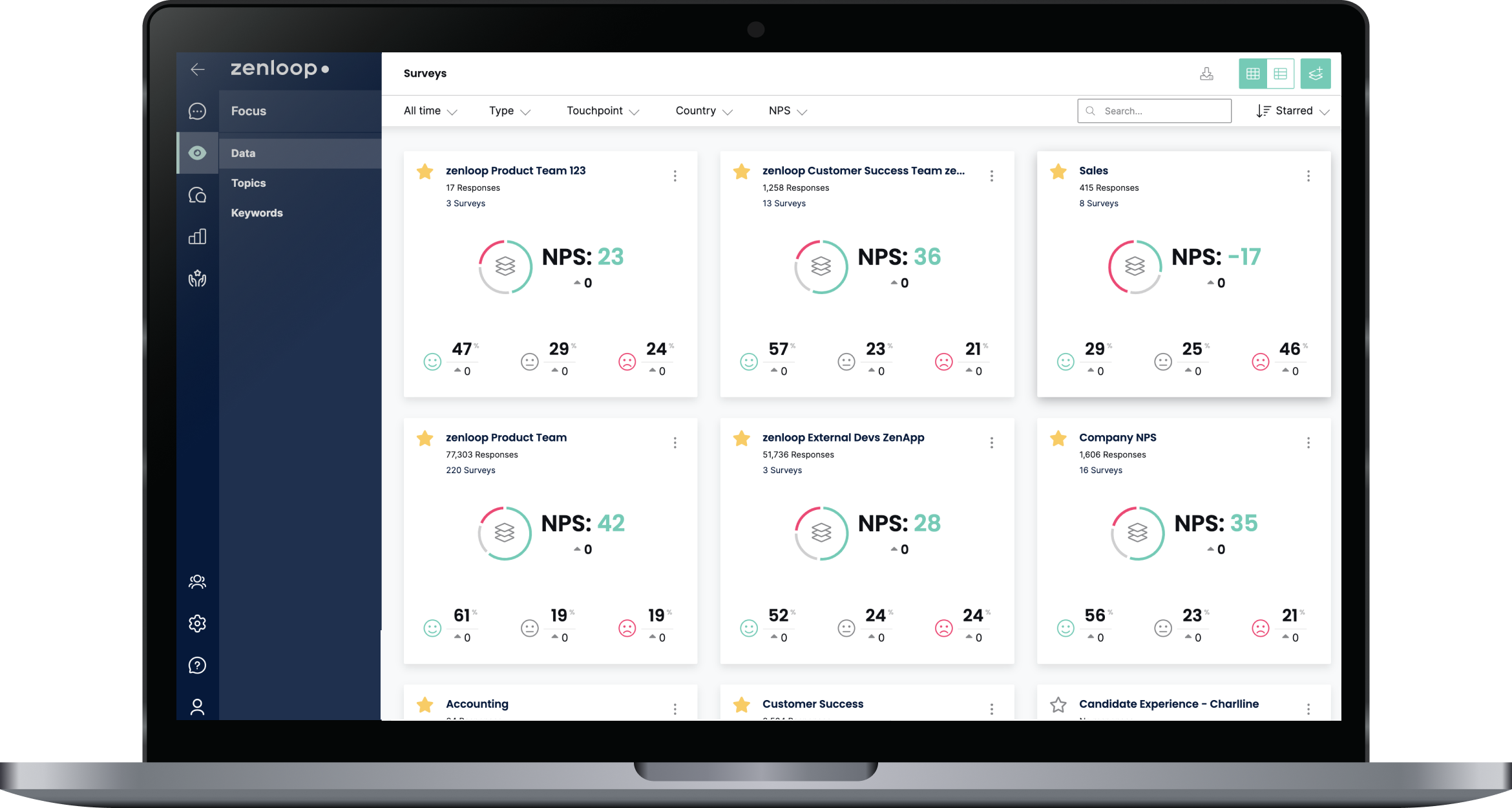
zenloop is built for mid-market and enterprise teams that need to act on feedback at scale. The platform collects NPS and other feedback at every brand touchpoint, then uses AI-powered analysis to identify which issues are driving churn and which customers need immediate attention.
Automated rules trigger win-back sequences for detractors and advocacy workflows for promoters. Internal routing sends feedback to the right stakeholders based on category and score, so CX insight reaches product, finance, or operations — not just the customer success team.
zenloop also offers industry-specific solutions for retail, energy, financial services, and internet services, with workflows built around the touchpoints and customer journeys relevant to each sector.
For teams that have outgrown manual follow-up and are looking for a practical alternative to complex enterprise implementations, zenloop is worth evaluating. Pricing is available on request at zenloop.com.
NPS Automation Software Comparison: 2026
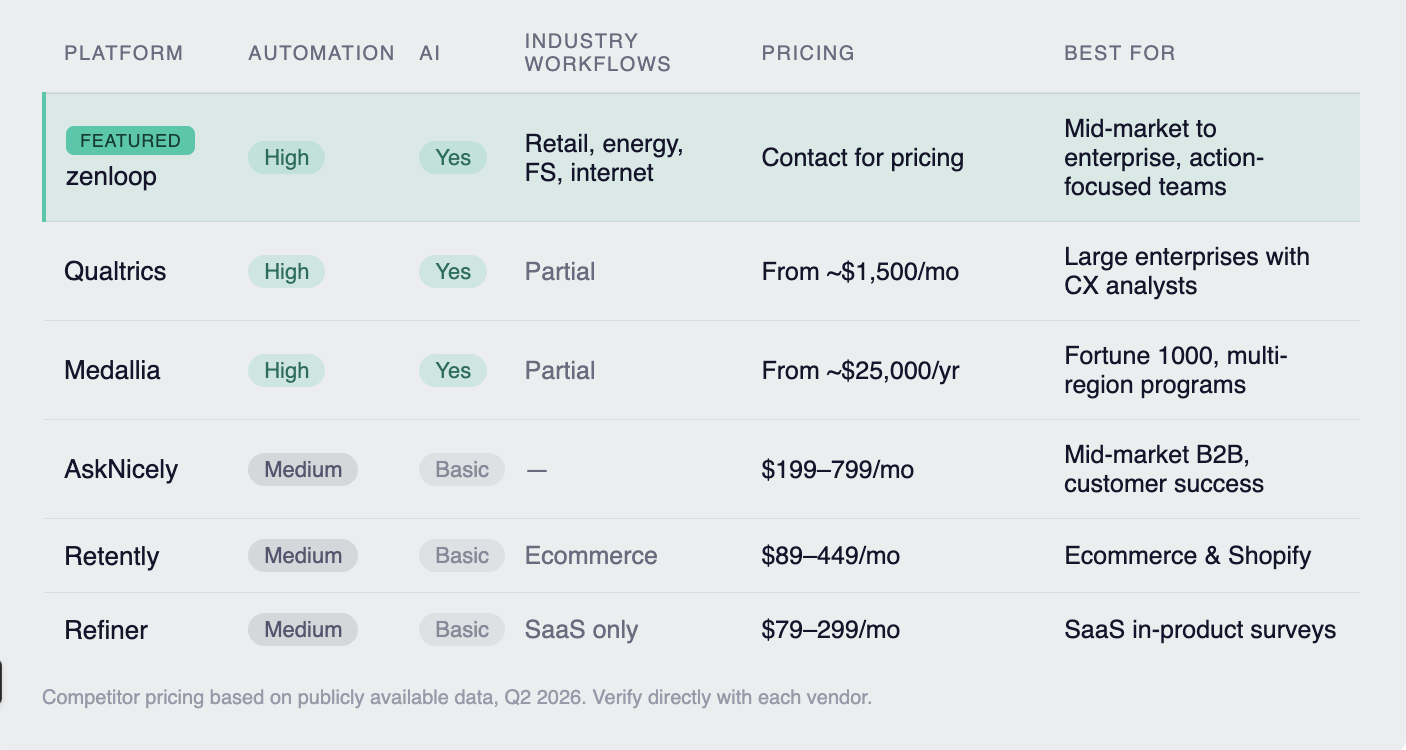
Note: Competitor pricing is based on publicly available information as of Q2 2026 and may have changed. We recommend verifying current pricing directly with each vendor before making a decision.
Qualtrics and Medallia offer powerful automation, but both typically require significant implementation time and budget. For a mid-market team that needs automation running within weeks, those timelines and price points can be a barrier.
AskNicely is faster to deploy but limited in AI depth and integration breadth. Retently works well for ecommerce but doesn’t extend cleanly into other verticals.
A note on Delighted: Delighted, previously a widely used option for simple NPS collection, has announced it is shutting down. Teams currently on Delighted should check the official timeline and prioritize migration planning accordingly.
FAQs
What is NPS automation software?
NPS automation software connects survey responses to triggered workflows. When a customer submits an NPS score, the platform automatically initiates an action, such as a win-back email for a detractor, an advocacy invitation for a promoter, or an internal alert to the relevant team. It removes the manual step between collecting feedback and acting on it. You can also use zenloop’s free NPS Calculator to calculate and benchmark your score.
How is NPS automation different from a standard NPS survey tool?
A standard NPS survey tool collects scores and displays them in a dashboard. NPS automation software goes further by triggering actions based on those scores. The difference is between measuring customer sentiment and actually doing something about it.
What workflows should I automate first?
Start with detractor win-back. It has the most direct impact on churn and is the easiest to justify to leadership. Once that’s running, add promoter advocacy activation, then passive conversion sequences.
Does NPS automation work for enterprise CX programs?
Yes, but the platform needs to support complex routing rules, multi-touchpoint collection, and integration with enterprise CRM and CDP tools. Platforms like zenloop are designed specifically for mid-market and enterprise programs that need automation without a lengthy implementation cycle.
Can NPS automation software integrate with Salesforce or HubSpot?
Most modern NPS automation platforms offer native integrations with major CRM tools. zenloop supports technology partner integrations across the customer journey. Confirm specific integration availability with any vendor before committing.
What happens to open-text feedback in an automated NPS program?
The best platforms use AI to analyze open-text responses at scale, categorize themes, detect sentiment, and surface patterns. This turns qualitative feedback into actionable insight without requiring manual review of every comment.
How quickly can NPS automation software be deployed?
It depends on the platform. Larger enterprise tools can take several months to implement fully. Platforms built for mid-market teams are generally designed for faster deployment, with industry-specific workflows available from day one.
Curious to see the full scope of the new zenloop platform?
Whether surveys, review management, or AI-powered analytics — we’d love to show you how to unlock every capability for your brand. Just reach out.
sales@zenloop.com | +49 30 91739927