Customer Satisfaction among Energy Providers 2025
Where do we stand – and how do we win in 2026?
Table of Contents
- Where does the Energy Sector stand today?
- How go German Energy Suppliers perform?
- The biggest Challenges across the Industry
- What are the decisive Factors influencing the German NPS?
- Success Story – Stadtwerke Kassel
- How Surveys reveal hidden Strengths in the Customer Journey
- How zenloop supports: Listen, Understand, Act
- Recommendations for Action for Energy Suppliers in 2026
Where does the Energy Sector stand today?
The energy sector is in the midst of a period of upheaval.
Several developments are significantly influencing customer satisfaction and NPS: 77% of customers do not trust their energy supplier, only 22% fully understand their electricity bill, 95% felt insufficiently supported during the energy crisis, and 58.6% actively prefer green electricity.
A look at other European countries shows that things can be done differently. While countries such as Sweden, Norway, and Finland achieve NPS scores of +25 or higher, Germany remains significantly behind with an NPS of -14 — as does the United Kingdom, which shares the same NPS score as Germany. The comparison makes one thing clear: poor customer satisfaction is not an inevitability, but a matter of strategy.

How go German Energy Suppliers perform?
There are also positive examples within Germany itself. Some providers demonstrate that excellent customer experience is entirely possible. Suppliers such as Green Planet Energy (NPS +32,7) and Eprimo (+24,6) are setting benchmarks.
At the same time, a look at the age structure reveals a clear warning signal: over 60% of young customers are dissatisfied. Those who lose this generation today will also lose the customers of tomorrow.
The biggest Challenges across the Industry
Our experience with municipal utilities shows that many suppliers struggle with similar issues. We repeatedly find that legacy technical systems, insufficient project capacity, and fragmented customer journeys make customer-centricity more difficult. Energy, mobility, and additional services are often viewed in isolation, yet from the customer’s perspective they belong together.
Added to this is the fact that customer experience is frequently perceived as one large, complex transformation project. In practice, however, the evidence shows that the starting point can be small, as long as feedback is gathered and used systematically.
Today, emotional connection to a brand is one of the most important factors for customers. Even though energy itself is not inherently emotional, customer expectations are particularly high, especially at sensitive moments such as a move or a tariff change. Creating positive customer experiences is therefore a central success factor and should be at the very top of municipal utilities’ priority lists.
In many organizations, departments continue to work in silos. As a result, topics related to customer experience and customer satisfaction often go unaddressed, as clear responsibilities are lacking and customer feedback is not consistently acted upon.
What are the decisive Factors influencing the German NPS?
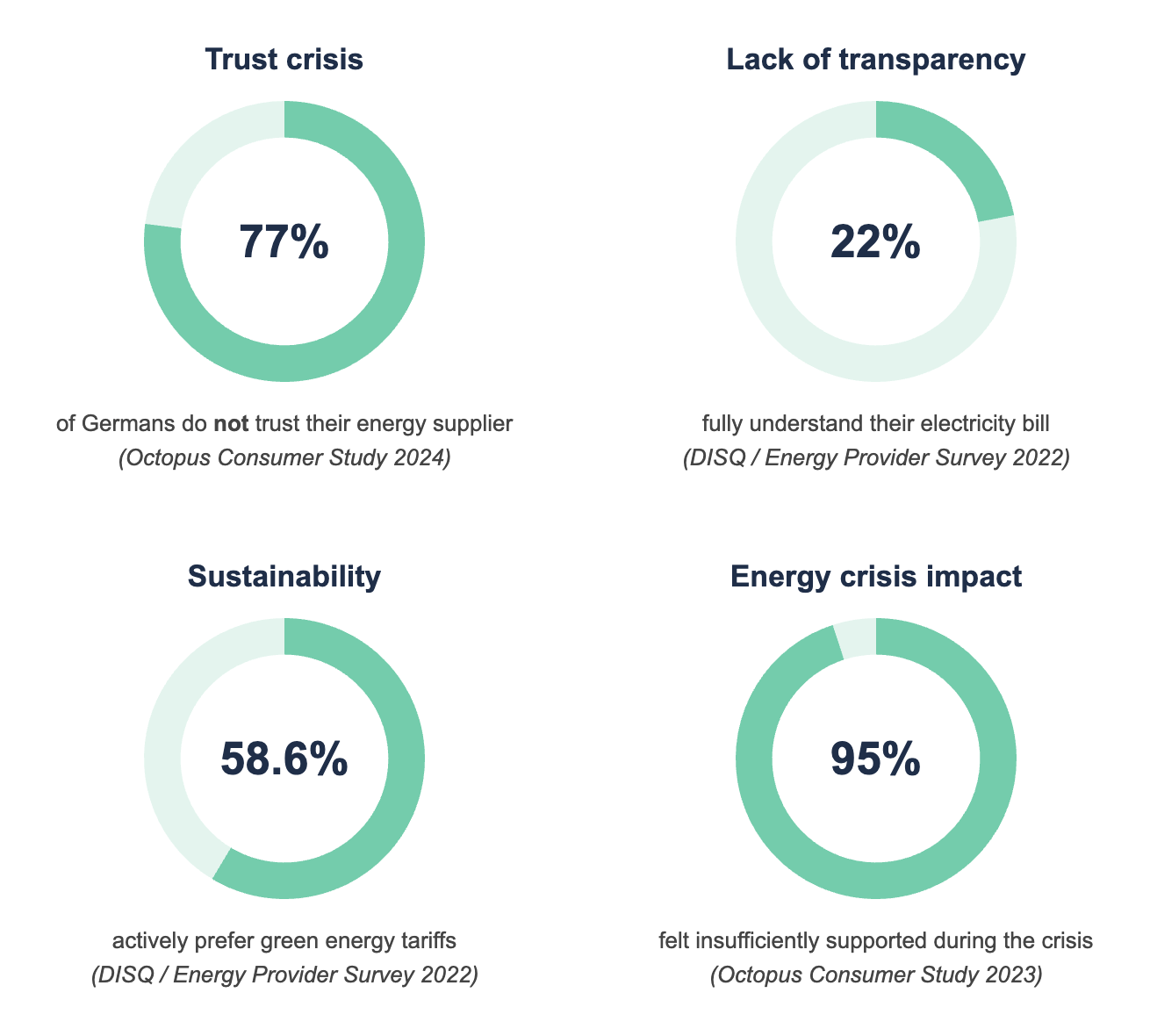
The graphic illustrates the key factors influencing the Net Promoter Score (NPS) of German energy suppliers.
A pronounced trust crisis plays a decisive role: 77% of Germans do not trust their energy supplier.
At the same time, a high degree of opacity is evident, as only 22% fully understand their electricity bill.
Sustainability is also gaining increasing importance, with 58,6% of customers actively preferring green energy tariffs.
The energy crisis has had a particularly strong impact on customer satisfaction: 95% of respondents felt insufficiently supported during this period. Together, these factors illustrate why customer-centricity and transparent communication are crucial for energy suppliers today.
Success Story – Stadtwerke Kassel
The effectiveness of this approach is demonstrated by Stadtwerke Kassel. Since 2022, they have been using zenloop to measurably improve customer experiences. Feedback is collected across more than 22 touchpoints along the entire customer journey — from digital processes to analog contact points.
The result: over 10,900 responses, more than 2,500 qualitative comments, and an impressive NPS of +54. CSAT and CES scores also reach top values of +7. This makes Stadtwerke Kassel one of the best-performing energy suppliers in Germany today.
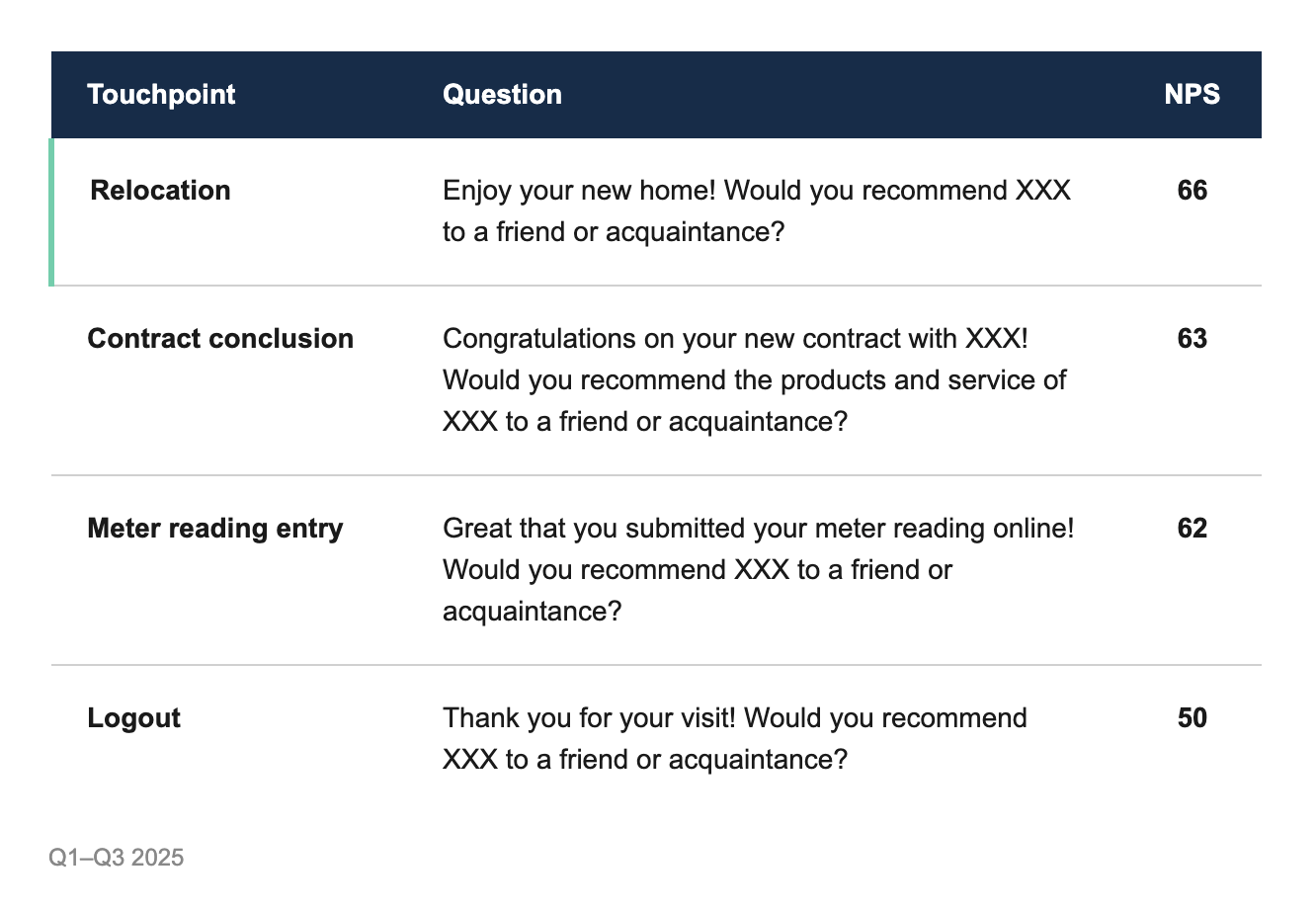 The following illustration shows four sample NPS surveys of a customer at different points along the customer journey, highlighting how significantly perceived customer satisfaction can vary depending on the touchpoint.
How zenloop supports: Listen, Understand, Act
Our recommendation is clear: place the customer consistently at the center. This requires more than individual surveys — what is decisive is a holistic approach built on listening, understanding, and acting.
Companies should systematically capture customer feedback across all relevant touchpoints, for example through standardized metrics such as NPS, CSAT, or CES, as well as individually customizable questionnaires. With the help of AI-powered analytics, customer opinions can then be automatically evaluated and categorized, and the key drivers of satisfaction or dissatisfaction identified. On this basis, companies can respond quickly: through automated notifications, workflow tools, and ticketing systems, insights are translated directly into concrete measures. In this way, feedback becomes measurable improvement — and genuine customer-centricity becomes embedded in everyday operations.
Recommendations for Action for Energy Suppliers in 2026
Based on all of this data, clear recommendations emerge.
The action recommendations for 2026 clearly show which levers energy companies can use to sustainably increase customer satisfaction. A central lever is closed-loop feedback: when dissatisfied customers are contacted within 24 to 48 hours — in some cases even automatically — up to 60% of detractors can be converted into passives or promoters.
In addition, clear and transparent communication plays a decisive role. Particularly when it comes to prices and bills, customers expect understandable explanations, early announcements, and comprehensible alternatives. This is complemented by the expansion of digital self-services, such as intuitive apps, chatbots, or simplified processes that support customers around the clock. Last but not least, internal NPS champions and a credible sustainability image contribute to building trust. When employees are empowered to handle feedback with empathy and customers are actively involved in the energy transition, a long-term, positive customer relationship is created.
Start Setting Up zenloop Surveys Now and Get to Know Your Customers Better Than Ever